Commercial real estate loan tracking
Commercial real estate debt management
TractTerm is borrower-side commercial real estate debt management software. It's the system of record for a property owner's loans: their real terms, their covenants, and the deadlines that carry real consequences when missed. TractTerm never moves money, and it isn't a lender.
In short
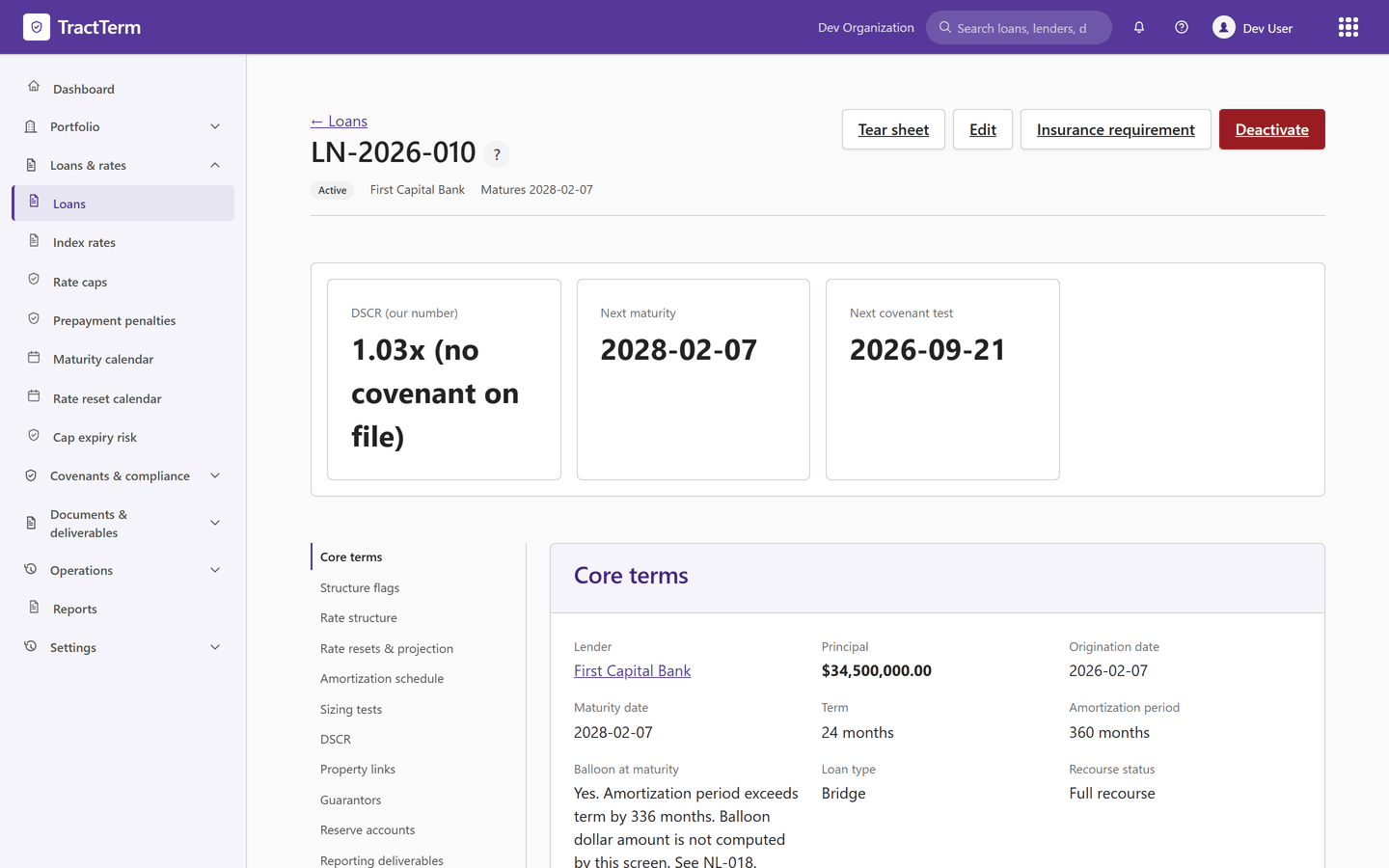
See every loan's real structure in one place: principal, dates, term versus amortization, and the balloon that produces.
DSCR computed twice: the lender's number and the borrower's number, using the lender's own NOI adjustment rules.
One calendar for every deadline that matters: maturities, rate resets, cap expirations, covenant tests, and reporting deliverables.
TractTerm never moves money and isn't a lender. Your lender still makes every credit decision.
Built for the person who owes the money
A property owner running fifty loans across a dozen lenders usually tracks them in a spreadsheet that one person updates once a quarter. That works until it doesn't. A covenant gets breached in the quarter it happens but isn't caught until the annual review. A rate cap expires before the loan matures. A maturity arrives with no refinance in motion. And being late on a reporting deliverable is itself a default, whether or not anything is actually wrong with the business.
TractTerm replaces that spreadsheet with a real system of record. Loan terms, covenant tests, and deadlines live in one place, driven by a single calendar with genuine lead time. It's a tracking, analytics, and reporting tool for a borrower's own debt. It is not a loan origination, underwriting, or servicing system, and it is not a fund administration platform. TractTerm is not a lender, and your lender still makes every credit decision.
What TractTerm does
Every loan's real structure
Principal, dates, term versus amortization, the balloon that produces, interest-only periods, and the full amortization schedule, including rate-reset recalculation.
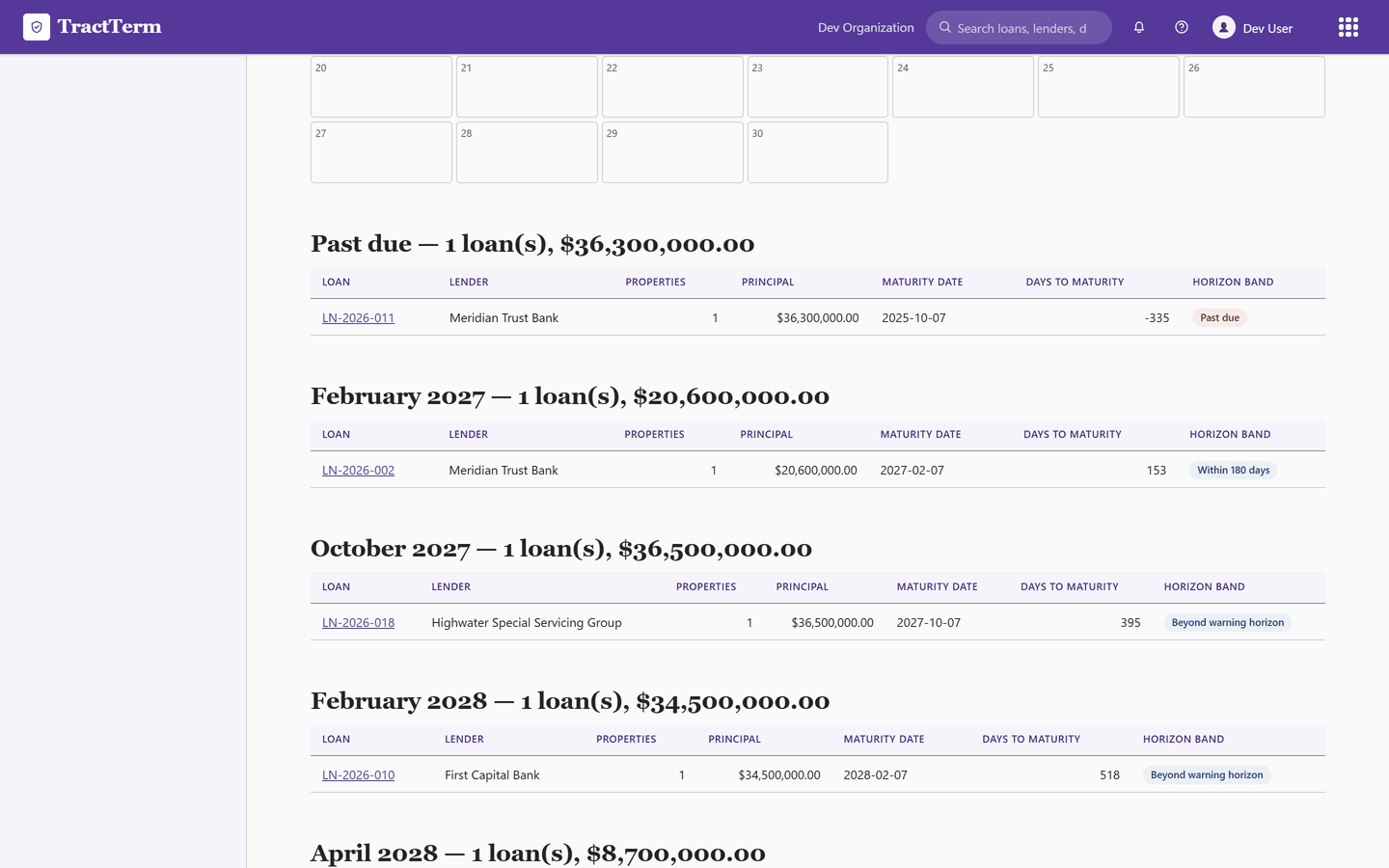
One calendar for every deadline
Maturities, rate resets, cap expirations, covenant tests, extension exercise-notice deadlines, and reporting deliverables, all on one calendar with configurable warning horizons.
DSCR, computed the way your lender computes it
DSCR runs twice, once as the lender computes it and once as you do, using the per-lender NOI adjustment rules that make the two figures legitimately different. LTV and debt yield run against effective-dated property valuations.
Covenant headroom and compliance certificates
A severity-ranked, portfolio-wide view of covenant headroom and breach detection, tied to compliance certificates you can generate straight from the data already in the system.
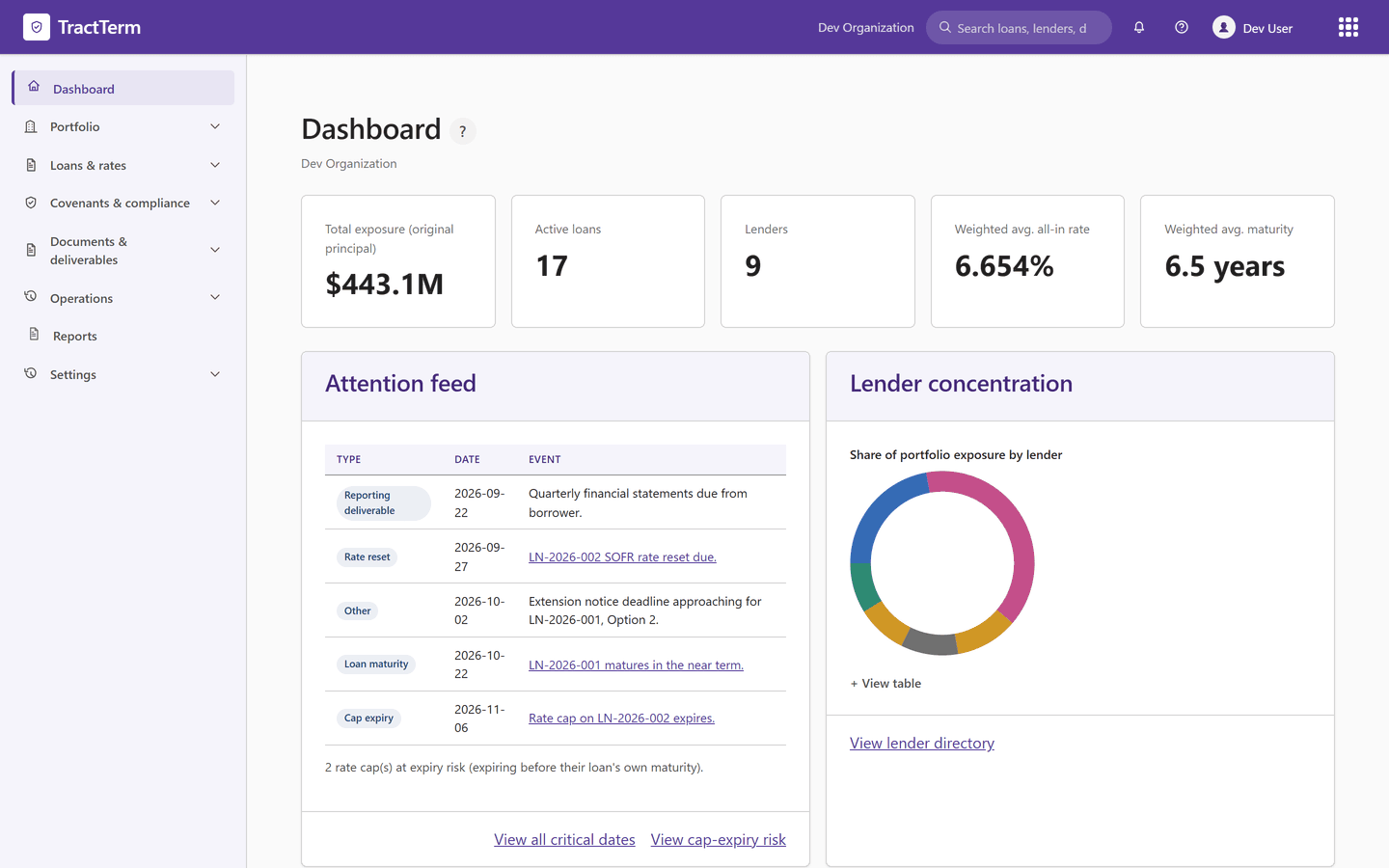
A portfolio debt dashboard
Total exposure, weighted average rate and maturity, covenant status, and alerts across the whole portfolio, in one place.
Start from the spreadsheet you already have
Bulk-import your existing loan tracking spreadsheet, or upload a note or amendment and let AI-assisted abstraction pull the key terms for you to review and confirm before they go live.
What TractTerm will never do
TractTerm never moves money. There are no payment rails, no escrow custody, no capital calls, and no disbursement execution. It can record that money moved elsewhere, like a reserve being funded or a payment being made, but it never moves the money itself. This boundary is deliberate and permanent. It's what keeps TractTerm a record-keeping and analytics tool rather than a regulated financial service.
TractTerm is also not a lender, originator, underwriter, or servicer, and it isn't affiliated with any specific lender or bank. It gives no legal, tax, or lending advice. Credit decisions, covenant determinations, and refinance approvals stay with your own lender, counsel, and accountant. TractTerm's job is narrower: to make sure you walk into those conversations knowing exactly where you stand.
TractTerm and Atlasafe, our insurance product, are both built by Composed Studio. If your organization uses both, you sign in with the same Composed Studio account, and TractTerm compares each loan's required coverage against what Atlasafe has reported for every human-confirmed property match, showing Satisfied, Short or expired, or Unknown per coverage line. A property is never matched from a shared address alone.